
Broward County Certificate of Competency 20-WD-21968-X
Why is water leaking around my window frames during heavy wind-driven rain?
A straight answer for Broward County homeowners, then what you can check yourself and when to call. Free estimate: (954) 906-1715.
Water showing up at the frame in heavy, wind-driven rain almost always means the seal between the window and the wall has failed, or the window's own drainage path is blocked — not that the glass is broken. Driving rain is pushed sideways and upward under pressure, so it finds gaps that a vertical rain shower never reaches: cracked perimeter caulk, a stucco-to-frame joint that has opened, a missing or damaged sill pan, or weep holes packed with dirt, paint or old sealant.
The nuance that changes the answer: water can enter well above the window and only appear at the frame. A stucco crack, a failed wall penetration, or a roof or soffit leak can run down inside the wall and exit at the first horizontal ledge it meets, which is usually the window head or sill. If the leak shows up only during storms from one direction, trace the wall above the opening before assuming the window is at fault.
Why it happens
Broward sits in the High-Velocity Hurricane Zone, and the rainy season from roughly May through October brings near-daily storms with intense wind-driven rain. Sealants and glazing gaskets in this climate take constant UV, heat and humidity, and near the coast and Intracoastal, salt air corrodes aluminum frames, fasteners and hardware. A joint that looked fine five years ago can be chalky, shrunken and open today.
Most windows are not watertight by design — they are designed to manage water. Rain that gets past the outer seal is meant to drop into the sill track and drain out through weep holes. When those weeps are blocked, the track fills and spills over the interior edge, which is why a leak can start suddenly in an otherwise sound window.
Older single-pane aluminum units are the frequent culprits in postwar block homes here: corroded corners, worn weatherstripping, loose sash locks that let the sash flex under pressure, and perimeter caulk that has been painted over several times. Those windows also have no HVHZ impact rating, so replacing a chronic leaker is often the point where homeowners move to impact-rated units and solve the water and the debris-protection issue in one pass.
What you can check yourself
Find where the water first appears
During or right after a storm, note whether water shows at the head, the jambs, the sill, or the wall below. Head and jamb leaks point to the wall and perimeter seal; sill leaks point to drainage.
Clear the weep holes
Look for small slots along the outside bottom edge of the frame and gently clear debris with a soft brush or a thin plastic pick. Never enlarge them or push sealant into them.
Inspect the perimeter caulk
Run a finger along the joint where the frame meets the stucco. Cracked, chalky, shrunken or missing sealant — especially at the top corners — is a direct entry path.
Look at the wall above the window
Stucco cracks, popped paint, rust stains or a damaged soffit above the opening can send water down inside the wall to the frame.
Check the sash and lock
Close and lock the window and look for daylight or compressed, hardened weatherstripping. A sash that does not pull tight will leak under wind pressure.
When to call a pro
Call when the leak returns after the weeps are cleared and the caulk is fresh, when drywall below the window is soft or stained, when you see rot in a wood sill or a corroded aluminum frame, or when water appears at more than one window on the same wall. Those point to flashing, pan or wall issues behind the finish — or to a window at the end of its service life — and they need the opening opened up to diagnose honestly.
If replacement is the answer, window work is permitted construction in Broward, including like-for-like impact replacements, and the permit comes from your city's building department (or Broward County Building Code Services in unincorporated areas); verify the exact submittal steps with your city's building department, and with your condo or HOA board, which usually has to approve as well. Cat 5 Home Shield installs impact windows under Broward County Certificate of Competency 20-WD-21968-X. Call (954) 906-1715 for a free estimate.
Impact Windows work is done under Broward County Certificate of Competency 20-WD-21968-X (windows, doors, shutters & garage doors).
What a pro will do
- Trace the source, not just the symptomWe look at the frame, the weeps, the perimeter joint and the wall above before recommending anything, so a wall leak is not treated as a window leak.
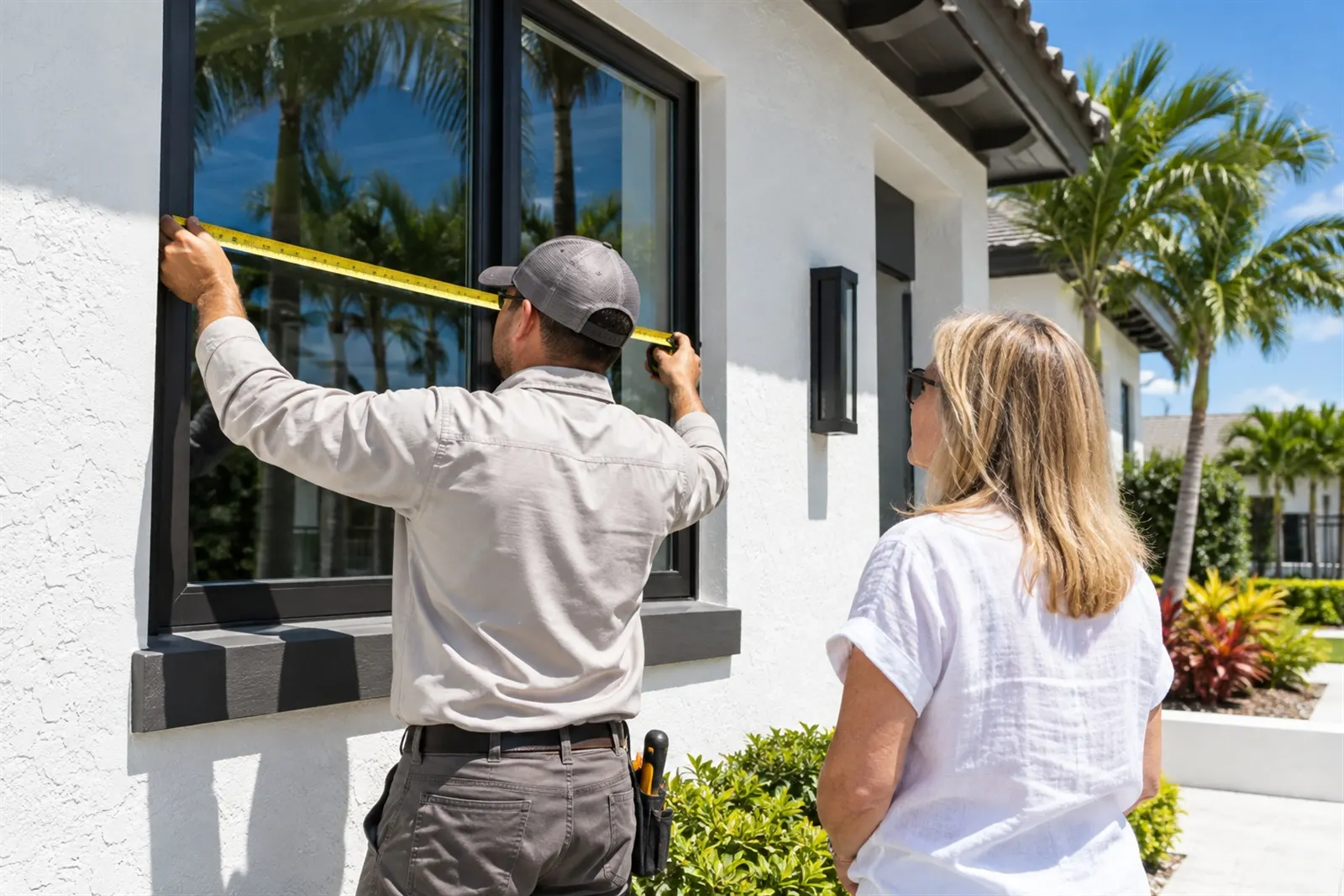
- Measure each openingReplacement windows are measured opening by opening and specified to the design pressures for that wall and height, not ordered as a generic size.
- Use HVHZ-approved productsWindows installed in Broward need a product approval valid for the High-Velocity Hurricane Zone, usually a Miami-Dade NOA covering impact and cyclic pressure testing.
- Anchor and seal to the approvalAnchors, spacing, substrate and sealing follow the product approval and engineering details — that attachment detail is what the inspector checks.
- Handle the permit through close-outWe pull the permit when the work needs one, schedule inspections and get the permit closed out.
Related questions
- Can re-caulking alone stop a wind-driven rain leak?
- Sometimes, if the only failure is the perimeter joint and the window itself is sound. If water is getting past the glazing gaskets, through a corroded frame corner, or down from inside the wall, caulk just hides the path for a season.
- Do impact windows stop water intrusion?
- Impact-rated windows are tested for water infiltration as part of their approval and are generally far more weather-tight than a worn single-pane aluminum unit. The installation matters as much as the window — the sealing and anchoring details in the approval are what keep water out.
- Does replacing my windows affect my insurance?
- Opening protection is one of the categories on Florida's uniform mitigation verification form OIR-B1-1802, and approved impact-rated windows can count toward it when protection is evaluated across all openings. Florida law requires insurers to offer discounts for wind-loss-mitigation features (s. 627.0629, Florida Statutes); amounts vary by insurer. We do not perform wind-mitigation inspections — a licensed inspector completes the form.
- What drives the cost of fixing or replacing a leaking window?
- The number and size of openings, the window type, access and floor level, the condition of the surrounding stucco or framing once it is opened up, the required design pressures, and the permit and inspection work. We give a free estimate after measuring — call (954) 906-1715.
- Do I need a permit to replace one leaking window?
- A permit is required for window replacement in Broward, including like-for-like impact replacements, with product approval and attachment details typically submitted with the application. Verify the specific requirements with your city's building department.
Get a free impact windows estimate
Tell us what's going on and where in Broward County the home is. We'll get back to you to set up a visit.
Prefer to talk?
(954) 906-1715