Broward County Certificate of Competency 20-WD-21968-X
What does white chalky powder on my aluminum window frames mean?
A straight answer for Broward County homeowners, then what you can check yourself and when to call. Free estimate: (954) 906-1715.
That white, chalky powder is almost always aluminum oxide — the aluminum frame is corroding where its paint, anodizing or factory finish has worn through. It is a sign of age and exposure, not an emergency, but on older frames it often travels with the problems that actually matter: pitting, seized hardware, leaking corners and anchors that have lost their bite.
One nuance changes the answer. If the powder is mostly on the stucco, sill or concrete below the window rather than on the metal itself, it may be efflorescence — mineral salts carried out of block or stucco by moisture — which points to water moving through the wall or around the window perimeter instead of frame corrosion. Powder on the metal is corrosion; powder on the masonry is a water clue.
Why it happens
Aluminum protects itself with a thin oxide skin. In Broward's year-round humidity, near-daily rainy-season storms and salt-laden air along the coast and Intracoastal, that reaction speeds up and the oxide builds into a loose white powder instead of staying tight and invisible. Intense UV and heat break down the original paint or anodized layer first, so bare metal is exposed and the chalking starts.
It shows up first where moisture sits longest: bottom rails, corners, weep areas, around fasteners, and anywhere dissimilar metals (steel screws in aluminum) are in contact. Salt deposits hold moisture against the metal, which is why homes closer to the ocean or Intracoastal usually see it sooner.
The powder itself is cosmetic. What matters is what is under it. Light chalking cleans off and leaves sound metal. Heavy chalking with pitting, flaking or white blooms at the joints usually means the frame has been wet for years, and on 1960s–1990s aluminum windows that often coincides with failed glazing seals, corroded hardware and a frame that no longer seals against wind-driven rain.
What you can check yourself
Wipe a small area
Wipe the powder off with a damp cloth and look at the metal underneath. Smooth, dull aluminum is cosmetic chalking; rough, pitted or flaking metal means corrosion has gone deeper.
Check the corners and bottom rail
Corrosion concentrated at the joints and bottom rail usually means water is being held in the frame. Look for staining on the sill or drywall below.
Find the weep holes
The small slots on the outside of the sill let water drain out. If they are packed with dirt, paint or caulk, clear the debris gently so water is not trapped against the frame.
Test operation and locks
Stiff sashes, gritty rollers or locks that no longer line up often go with corroded frames. Do not force a stuck sash — that can bend the frame or break glass.
Watch it during a rainstorm
Look for water tracking in at the corners or under the sill during wind-driven rain. That turns a cosmetic question into a water-intrusion question.
When to call a pro
Call when the powder comes with pitted or flaking metal, leaks at the corners, fogged or loose glass, hardware you cannot operate, or frames that visibly move when you press on them. At that point the frame is no longer sealing or holding its anchors, and cleaning and repainting only hides it.
If replacement is the answer, every window installed in Broward must carry product approval valid for the High-Velocity Hurricane Zone — usually a Miami-Dade NOA covering large- and small-missile impact and cyclic pressure — and be rated for the design pressures at that specific opening. A permit is required for window replacement, including like-for-like, through your city's building department (or Broward County Building Code Services in unincorporated areas), with inspections and a closed-out permit at the end; condo and HOA approval is usually required too, so verify the steps with your city's building department. Cat 5 Home Shield works under Broward County Certificate of Competency 20-WD-21968-X, which covers windows, doors, shutters and garage doors, and we serve Broward County only. Cost depends on the number and size of openings, frame condition once the old unit is out, access, stucco and finish repairs, glass type and permit fees — call (954) 906-1715 for a free estimate.
Impact Windows work is done under Broward County Certificate of Competency 20-WD-21968-X (windows, doors, shutters & garage doors).
What a pro will do
- Assess the frame, not just the powderWe check for pitting, failed seals, corroded anchors and water staining to tell cosmetic chalking from a frame at the end of its life.
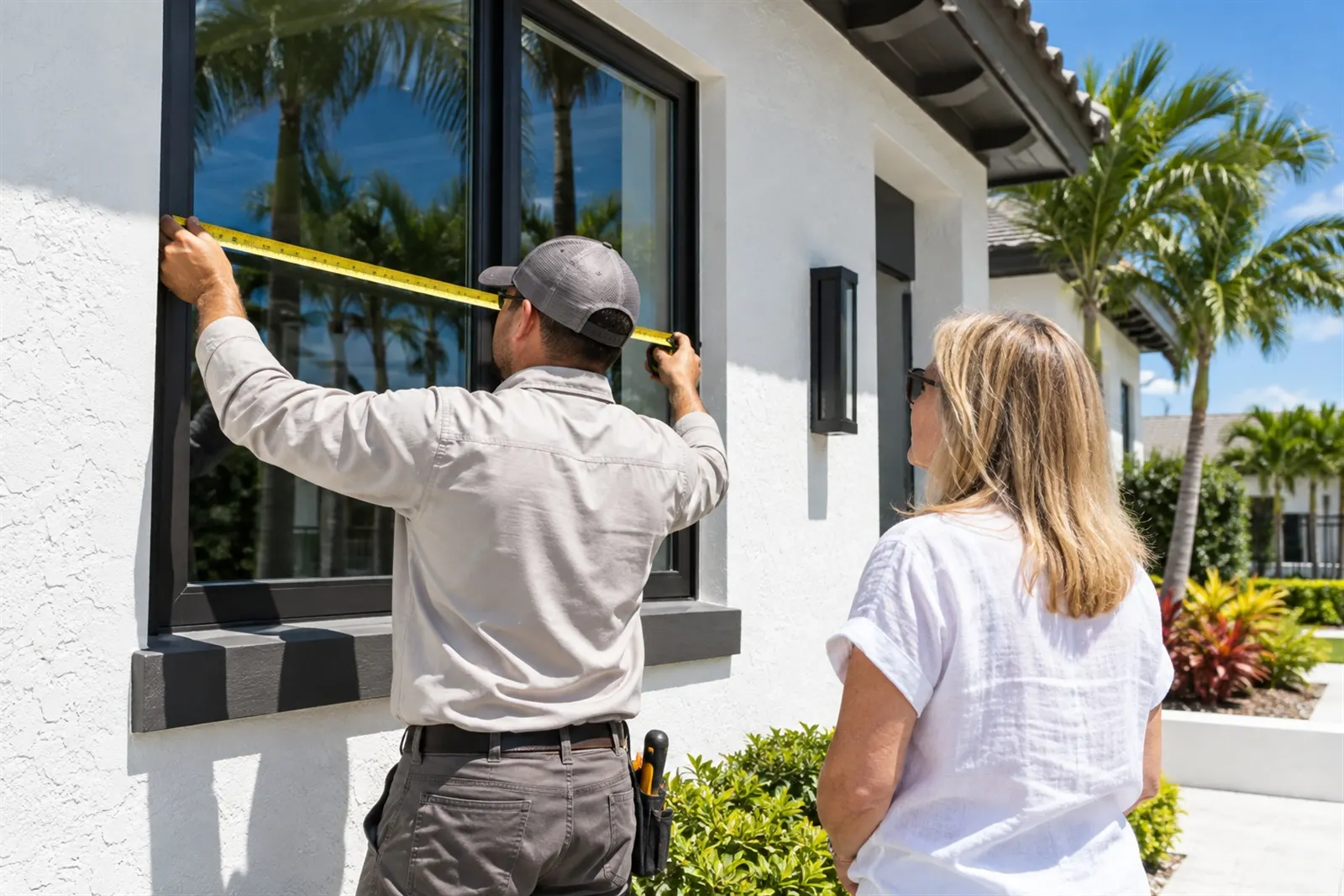
- Measure each openingEvery opening is measured individually and matched to design pressures, egress, fall protection and safety glazing requirements.
- Select HVHZ-approved productsImpact-rated single-hung, horizontal-roller, casement or fixed windows with an approval valid for the HVHZ, usually a Miami-Dade NOA.
- Install and anchor to the approvalAnchors, spacing and sealing follow the product approval and engineering details, which is what the inspector checks.
- Permits and closeoutWe pull the permit when the work needs one, schedule inspections and get the permit closed out.
Related questions
- Can I just clean and repaint the chalky aluminum instead?
- If the metal under the powder is smooth and the window still seals and operates, cleaning and refinishing is a reasonable cosmetic fix. Once there is pitting, leaking or seized hardware, refinishing covers the symptom and the frame keeps deteriorating.
- Does the white powder mean my windows are not hurricane rated?
- Not by itself — chalking is about the finish, not the rating. However, most heavily chalked aluminum frames in Broward are older non-impact units installed before current High-Velocity Hurricane Zone requirements; check for a permanent etched or labeled approval marking on the glass or frame.
- Why is it worse on the windows facing the water?
- Salt air near the ocean and Intracoastal deposits salts that hold moisture against the aluminum, and those elevations usually take the most sun and wind-driven rain. Rinsing exposed frames and tracks with fresh water now and then slows it down.
- Will replacing corroded aluminum windows with impact windows help with insurance?
- Approved impact windows can count toward the opening protection category of Florida's wind-mitigation form OIR-B1-1802, which a licensed inspector completes; we do not perform those inspections. Florida law requires insurers to offer discounts for wind-loss-mitigation features (s. 627.0629, Florida Statutes), and protection is evaluated across all openings. You can try the free Wind Mitigation Credit Checker on this site.
- How far ahead should I order replacement windows?
- Manufacturing lead times often run months, and orders peak in spring and early summer before hurricane season starts June 1. The dry winter months usually have the shortest lead times.
Get a free impact windows estimate
Tell us what's going on and where in Broward County the home is. We'll get back to you to set up a visit.
Prefer to talk?
(954) 906-1715