
Broward County Certificate of Competency 20-WD-21968-X
Why has my single-hung window become hard to open and close?
A straight answer for Broward County homeowners, then what you can check yourself and when to call. Free estimate: (954) 906-1715.
A single-hung window usually gets hard to move because of dirty or corroded tracks, worn-out sash balances, swollen or painted-over edges, or a frame that has shifted out of square. In Broward's humid, salt-influenced air, track corrosion and failing balances are common reasons an older aluminum window starts to bind.
The nuance is whether the problem is the window's moving parts or the window itself. Grit and a dry track are a cleaning job. A bent sash, a corroded frame or a window that has water damage around it is a sign the unit may be near the end of its life.
Why single-hung windows start to stick
In a single-hung window only the bottom sash moves, and it rides in side channels held up by balances (springs or a cord-and-weight style mechanism). Over time the balances weaken, the channels fill with dirt, pollen and dried-up lubricant, and the sash starts to drag or tilt. Humidity adds to this: aluminum corrodes and swells with white oxide, and wood or vinyl-clad parts can swell or collect mildew.
Building movement and paint play a part too. Many Broward homes are concrete block with stucco, and slight settling, a past stucco repair or a poorly done earlier install can leave the opening a little out of square, so the sash pinches. Layers of paint or caulk on the stops and sash edges can also glue a window nearly shut.
If your window is an impact-rated unit, the laminated glass makes the sash heavier than standard glass. Worn balances or a misaligned frame then show up sooner. Sticking can also point to a frame that was anchored unevenly, which is worth having looked at, because the anchoring is what the window's wind rating depends on.
What you can check yourself
Make sure it is fully unlatched
Confirm the lock is completely open and that nothing is catching, such as a window limiter or a security stop. Never force a sash that resists.
Clean the tracks
Vacuum the side channels and sill, then wipe with a damp cloth and mild soap. Built-up grit is the simplest cause to remove.
Lubricate lightly
A silicone-based spray on clean tracks can help. Avoid oily products that attract dirt, and keep spray off the glass and the seals.
Look for paint or caulk
Check the edges of the sash and the stops for dried paint or sealant that may be bonding the parts together.
Inspect the frame
Look for white powdery corrosion, gaps at the corners, stains or soft spots around the frame, and a sash that sits crooked. Those point to more than a cleaning problem.
When to call a pro
Call us if cleaning doesn't help, the sash tilts or won't stay up, the glass or frame is cracked or corroded, or you see water stains around the window. Balance replacement and frame straightening are best left to a professional, and a window that won't close or lock fully is not offering the protection it was meant to.
If the window needs replacing, that is permitted work in Broward, including like-for-like impact replacements. Your city's building department issues the permit, and the application typically needs product approval documents and attachment details. In the High-Velocity Hurricane Zone the window needs a Miami-Dade NOA or an equivalent approval valid for the HVHZ. Condo and HOA approval is usually needed as well, so verify with your city's building department and your association. Our window and door work is done under Broward County Certificate of Competency 20-WD-21968-X.
Impact Windows work is done under Broward County Certificate of Competency 20-WD-21968-X (windows, doors, shutters & garage doors).
What a pro will do
- Diagnose the causeWe check the tracks, balances, sash, frame squareness and the condition of the surrounding opening to see whether a repair makes sense.
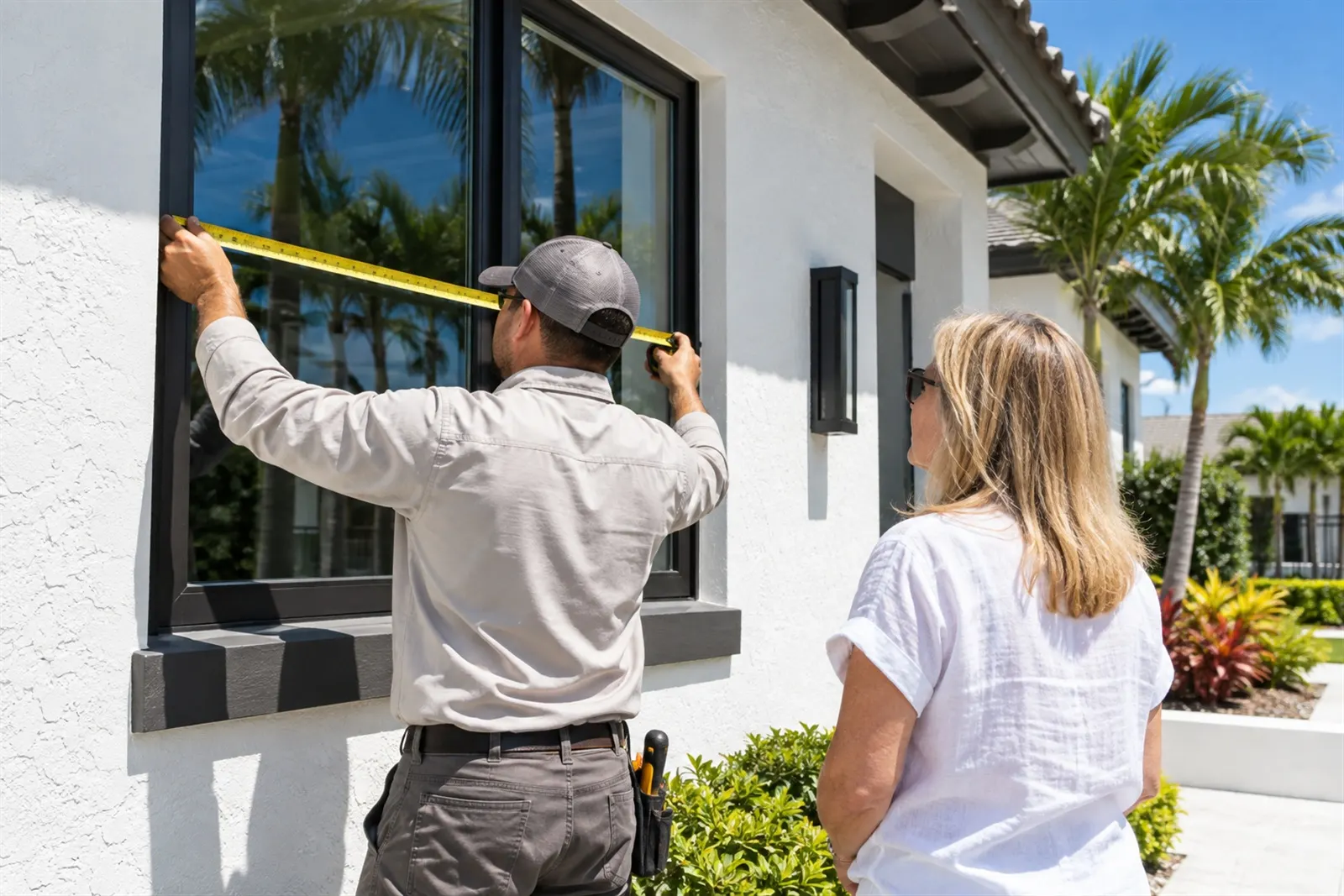
- Measure for replacement if neededIf the unit is worn out or corroded, we measure each opening and recommend an impact-rated single-hung window approved for the HVHZ.
- Install and anchor to the approvalThe new window is set and anchored as the product approval specifies, which is what lets it perform as rated.
- Handle permits and inspectionsWe pull the permit when the work needs one, schedule the inspections and see the permit closed out.
Related questions
- Can I just replace the balances instead of the whole window?
- Sometimes, if the frame and sash are sound and replacement parts are available for that make. On older or corroded units, the parts are often hard to find and the frame itself may be the problem. We can look at it and tell you which route makes sense.
- Will an old window that sticks count for wind mitigation?
- On form OIR-B1-1802, opening protection is evaluated across all openings and depends on approved protection, not on whether a window opens smoothly. Florida law (s. 627.0629) requires insurers to offer discounts for wind-loss-mitigation features. The free Wind Mitigation Credit Checker on this site can help you see where you stand.
- Does a stiff window mean it will leak?
- Not always, but a sash that doesn't seat tightly, or worn weatherstripping, can let wind-driven rain in during a summer storm. Staining or soft material around the frame suggests water is already getting in.
- Is a replacement window permitted work?
- Yes. A permit is required for window replacement in Broward, including like-for-like. Verify the exact steps with your city's building department, or with Broward County Building Code Services if you are in an unincorporated area.
Get a free impact windows estimate
Tell us what's going on and where in Broward County the home is. We'll get back to you to set up a visit.
Prefer to talk?
(954) 906-1715